



From AI Strategy to Execution: What Separates the 19% From Everyone Else
The organizations delivering measurable business impact from AI are not outspending the competition. They structure, lead, and govern differently. Here is the data on how.

Inside the Execution Gap
Riviera Partners’ 2026 Future of Tech Leadership research surveyed nearly 1,000 technology leaders to understand why the business case for getting this right is measurable: Advanced organizations are nearly twice as likely to report business value from AI (44% vs. 27% for Emerging organizations).
The report’s findings are designed for technology executives responsible for AI strategy, organizational design, and the teams behind execution.

43%
of organizations say they are scaling AI or fully embedded.
35%
consistently move more than 60% of AI initiatives into production.
19%
have reached Advanced AI execution maturity.
Understanding what drives that gap starts with where most organizations actually stand.
Assessing AI Maturity
To understand what separates high performers from the rest, Riviera developed the AI Execution Maturity Model, based on three dimensions observed consistently across the data.
AI Execution Maturity Model
Organizations are categorized based on three core operational dimensions.
Emerging
Operates with fragmented technology structures, less engaged leadership, and governance introduced late or on an ad hoc basis.

AI execution remains inconsistent and difficult to scale.
Developing
Has partially aligned technology functions, a mix of leadership engagement styles, and governance
introduced during development.
Execution is repeatable but remains inconsistent across the business.
Advanced
Operates with a unified technology structure, hands-on leadership, and governance integrated from the initial design phase.
These organizations are best positioned to move AI into production, scale it across the enterprise, and generate measurable business impact.
Technology structure
(Coordination)
Whether technology functions are unified or siloed.
Leadership engagement
(Behavior)
Whether leaders are hands-on player-coaches or strategy focused.
Governance integration
(Agility)
Whether securityand governance are embedded from the start or bolted on later.
AI Execution Maturity distribution across 958 surveyed tech leaders.
43%
Emerging
35%
Developing
19%
Advanced
Advanced organizations are significantly more likely to report measurable AI business value (44% vs. 27% for Emerging) and far more likely to move initiatives consistently into production and across the enterprise.
Organizational Design
How an organization structures its core technology functions is the most consistent predictor of AI execution outcomes.
Technology structure evolves with Al execution maturity
% of organizations by how Data, Product, and Engineering functions report.
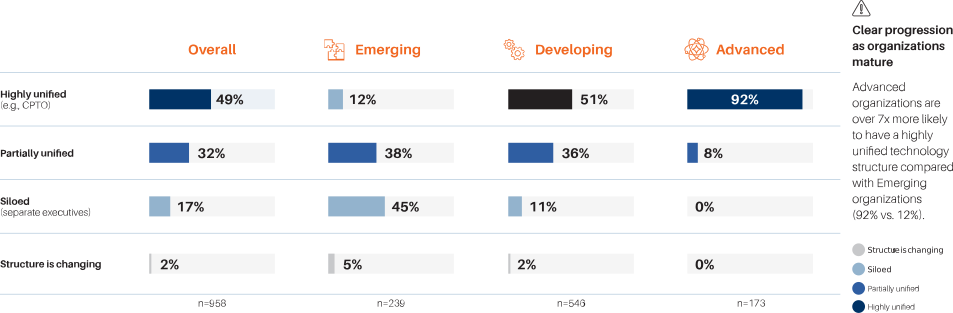
92% of Advanced organizations have highly unified technology structures. By contrast, 45% of Emerging organizations keep Product, Data, and Engineering in separate reporting lines, creating coordination friction at every stage.
The production impact is direct. Among organizations with fully siloed functions, only 22% move more than 60% of AI initiatives into production, the lowest rate in the study.

“Organizations do not reach Advanced execution maturity simply because they appoint the right AI leader. They reach it because they redesign how technology functions work together.”
Appointing a Chief AI Officer addresses accountability. It does not eliminate fragmented reporting lines or the handoffs that slow delivery. 20% of organizations have a CAIO. The role alone does not predict execution success. Structural alignment, not executive title, moves AI from strategy to production.
Leadership Behavior
The organizations achieving consistent AI execution share one leadership characteristic: technology leaders who stay actively engaged in decisions, tradeoffs, and delivery.
This is not a question of leadership quality. It is a question of leadership proximity.
The research identifies the player-coach model, balancing strategic direction with hands-on involvement in architecture, governance, and delivery, as the leadership behavior most associated with Advanced maturity.
Yet only 13% of CEOs report using a player-coach model, compared to 21% of all respondents. More than half of respondents (55%) identify execution discipline as a likely leadership shortfall, up from 42% in 2025.
Leaders who stay close to execution remove obstacles faster and sustain the momentum AI scaling requires.

42%
of technology leaders at Advanced organizations spend more than half of their time directly engaged with AI execution, compared to 18% at Emerging organizations.
Building for Scale
Reaching Advanced AI execution maturity is not primarily a function of AI investment. It depends on whether organizations build internal capability or rely on third-party tools to approximate it.
Among organizations reporting no meaningful AI impact, 63% rely primarily on SaaS-first strategies. Organizations generating measurable impact consistently pair technology investments with the internal capacity to execute and scale them. Governance timing follows a similar pattern.
Governance moves earlier as Al execution matures
Point in the Al development lifecycle when cybersecurity, legal, and governance are first integrated.

Governance evolves from review to design partnership

The full research is available now.
The 2026 Future of Tech Leadership report details the structures, leadership behaviors, and governance practices that separate Advanced organizations from the rest, drawing on nearly 1,000 technology leaders across North America and Europe.
The full research is available now.
Watch Riviera Partners CEO Michael Newcomer, AI Practice Co-lead Kyle Langworthy and Head of Talent Advisory Josh Narva discuss what separates the 19% of Advanced organizations, what the maturity model reveals and what it means for how you lead and hire.
Frequently Asked Questions
More Resources
About Riviera Partners
Riviera helps people and companies reach their full potential. As the go-to executive search partner focused on technology leadership roles—including CIO, CTO, CISO, CDO, CAIO, Engineering, and Product—we partner with leading private equity firms, venture-backed companies, and public enterprises across North America and Europe.